

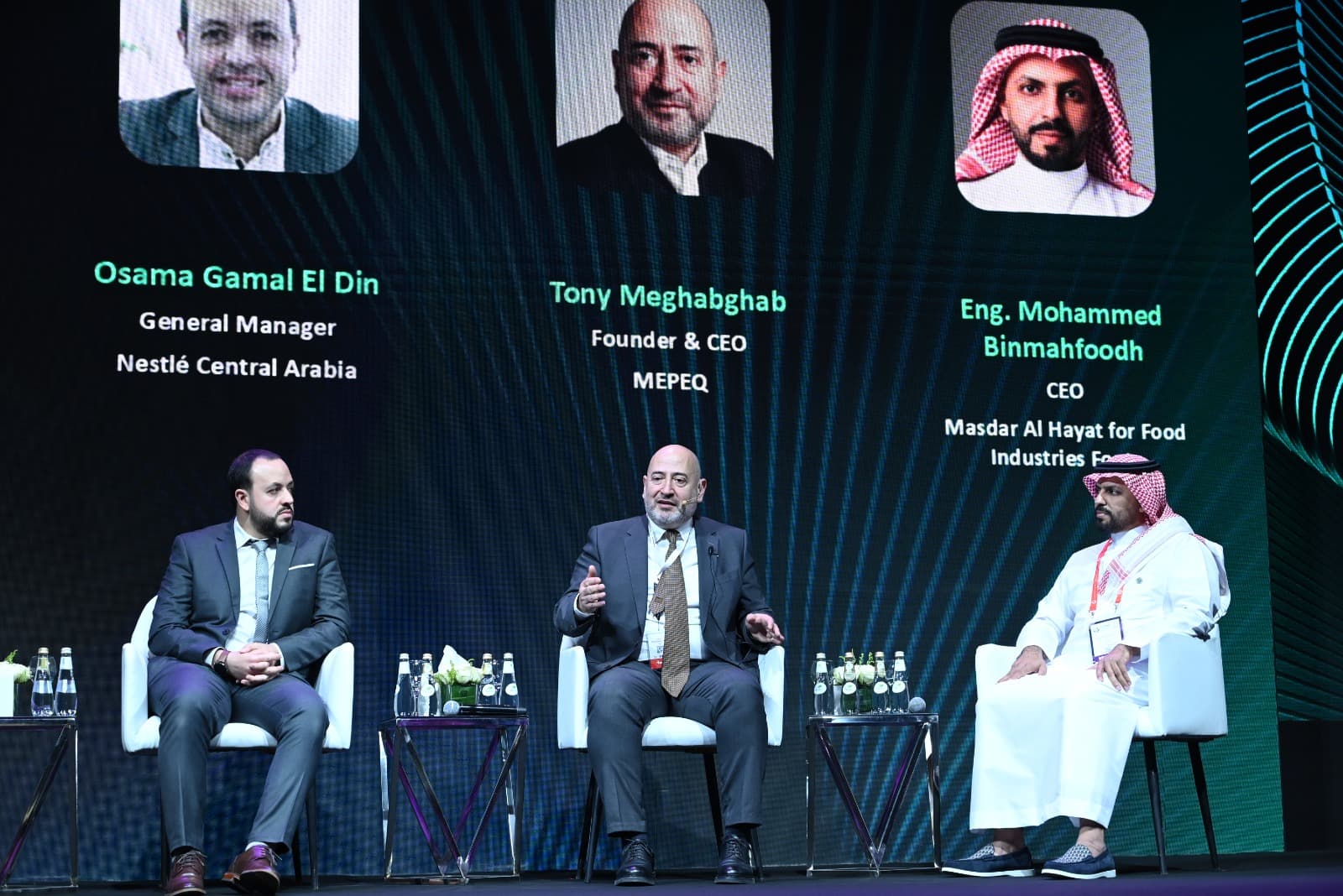

Riyadh, KSA -- Under the Theme “Raising the Kingdom’s Fast-Growing Food Manufacturing and Processing Sector to New Heights,” the Food Forward Summit on 13 April brought together global experts, thought leaders, and decision-makers to explore innovation economics, green solutions, diversification, and advanced manufacturing.
Speaking at a panel on capturing the long-term gains from operations excellence programs, Meghabghab tackled the production shifts and the move towards automation and digitalization to operate existing facilities efficiently and to steer competitive advantage.
He said: “Before Vision 2030, automation in Saudi Arabia was seen as a luxury, driven mainly by economic returns and hindered by the availability of cheap foreign labor. This led to a slower adoption compared to Western countries. Vision 2030, however, marked a turning point by introducing government-backed initiatives that encouraged smart manufacturing and reduced reliance on manual labor.”
Meghabghab highlighted that “while automation and robotics are part of Industry 3.0, Industry 4.0 focuses more on digitalization and connectivity,” adding: “These advancements offer intangible, long-term benefits. Digitalization and connectivity serve as enablers for the future -- steps forward rather than destinations. As a result, factories today grapple with various challenges and implementation is lagging behind that of other industries.”
Transformation Begins with People: Upskilling, Trust, and the Human Role in Industry 4.0
Speaking about some of these challenges, Meghabghab said: “The challenge is not technical at all. Technology today has all the tools for successful and scalable implementation in the most complex systems, from old and legacy machines to new, fully required, and modernized machines.
He went on to say: "The challenge is convincing the people at the heart of everything that their efforts will serve the greater good of humanity -- not just benefit business owners -- and that they will be supported with upskilling to transition into more comfortable and fulfilling roles, rather than replaced. Therefore, the key is effective change management and educating people within the organization about the future, in order to reduce resistance and ensure they are onboard to support and drive the transformation."
On how digitalization and connectivity assist the food industry in achieving operational excellence, Meghabghab noted that “operational excellence is the ability to produce the fastest and cheapest outcome with minimal waste while continuously improving processes, making data collection the cornerstone of a well-established system. Achieving and sustaining operational excellence requires comprehensive involvement from the entire hierarchy within a factory, necessitating a suitable culture, an experienced team, and commitment from all stakeholders involved, which is centrally about Humans. This is often successful when the team is skilled and has worked together for an extended period, but this is not always the case.”
Highlighting the added value of digitalization, he said: “With the digitalization of the shop floor, data, the cornerstone of operational excellence, are collected in an automated way and occur in real time, promoting transparency that supports a well-established process. This enhances the sustainability of operational excellence over time with minimal effort and independent of workforce dynamics in monitoring.
Emphasizing the future-proof nature of digitalization, he said: “In addition to sustaining an operational excellence system put in place by humans, digitalization and connectivity enable rapid corrective actions to deviations when data is available in real-time, thus allowing for automated and instant decision-making, which could later be assigned to AI agents.”
With the participation of international speaker, the Food Forward Summit also covered topics such as entrepreneurship, smart factories, investment, and technology, setting new benchmarks for industry excellence.